

‘$10,000 or no speak’: Inside Toronto’s luxury counterfeit industry with ties to overseas gangs

The perfect idea of “status” results in dire consequences for workers churning out fake designer goods in overseas factories
By: Charlene Anni Hatcher

TORONTO — When four-year-old Hannah Lee walked into Louis Vuitton, her heart was captured by what she saw: rows and rows of brown purses bearing the iconic LV monogram.
“I just remember crying and begging my parents for a bag,” she said. “They obviously didn’t buy me one, which was good parenting on their part, but I just wanted it so much.”
Fast forward two-decades later, Lee is now a life-long collector of vintage designer bags.
When she found a $60 Prada “re-edition” on the online shopping page The Real Real (TRR), she quickly scooped it up. However, after she got the item and noticed uneven stitching and flimsy material, she began to suspect she had been scammed. An online authenticator confirmed her suspicions and, even though she wasn’t surprised she’d happened upon a fake, she began to authenticate her collection of more than 20 luxury bags, “just to be sure”.
The growing counterfeit market draws in thousands of dollars every year, with Canadian and American border services seizing billions of dollars worth of counterfeit goods combined last year, according to Lipkus Law, a Toronto-based firm specializing in counterfeit lawsuits.
The problem is, super-fakes are getting so good, retailers like TRR, which sells designer items at a fraction of the off-the-rack cost and has a 100 per cent authenticity guarantee, are finding out they’ve sold fakes, usually after the item has been purchased. The brand would not comment on the matter and again insisted their authentication process is “rigorous,” leading Lee to say she “gave up” trying to contact them about the issue when it took too long to resolve.

What has been a long-standing global issue is now becoming more localized, says Robert Whalen, a former Toronto Police Service detective with three decades of experience on the force. Now chair of the Canadian Anti-Counterfeiting Network, Whalen works closely with law enforcement to find and prevent the sale of fakes, which is protected under government regulations.
The Combating Counterfeit Products Act (CCPA) was tabled by the Harper government in 2014 in an attempt to stop the importation of counterfeits into Canada. The act allows border security to more rigorously check shipments entering and leaving the country and lay harsher penalties on those caught knowingly buying or distributing counterfeit goods. However, there is limited data available on the law’s effectiveness. Canadian Border Services Agency (CBSA) said in a statement that they only reach out to the Royal Canadian Mounted Police (RCMP) “if there is a health, safety or security concern,” which is considered “federal jurisdiction” and no longer a border issue. If not, the goods are “detained” until the
rights holder comments on if they would like to pursue a lawsuit.
If the rights holder refuses, “the goods are released to the importer,” the statement goes on to say. However, Canada lags behind its American and European counterparts in terms of seizures. In 2024, CBSA intercepted 400 shipments of suspected luxury goods, which pales in comparison to the thousands of shipments seized in the U.S. and the European Union (EU), the latter alleging nearly six per cent of all goods imported into the continent were fakes, most of which were confiscated before entry. The Organization for Economic Cooperation and Development (OECD) published their findings in 2025,
linking more than half of the EU’s counterfeit imports to Chinese manufacturers and child labour and hazardous conditions.
Not only have counterfeit sellers become skilled at shipping their goods - using multiple names, addresses and sending small amounts of items over a long period of time - Whalen says the CCPA has done little to support border security, offering no authentication training or giving local police forces the ability to inspect international shipments, with roughly one in 1,000 shipping containers being inspected at Canadian ports annually, a staggering 0.1 per cent. A March 2024 shipment arriving in British Columbia saw more than 30,000 counterfeit luxury goods enter the country from Asia; the investigation was widespread according to CBSA, who says 14 rights holders were involved in the case. Eventually, matters
like this will end up in the hands of the RCMP, who will most likely pass the case off to the rights holders’ attorneys, Whalen says, an effort CBSA makes to keep goods moving at a steady pace and into Canadian stores.
“We don't really have a dedicated [police] team in Canada, like they do in the United States that enforce counterfeiting investigations. So CBSA has to walk a fine line between enforcing inspections and the ability for the Canadian citizens to get their products.”
For some designer store employees, the counterfeit market means they can no longer offer authentication services on-site, instead sending items to the head office. One Toronto Gucci employee, who is not being identified because of a Gucci policy barring employees from speaking to reporters, says he can’t tell when a person has a fake bag anymore, even though he’s aware the issue is more common than when he started
working with the designer a decade ago.
“We don’t get any training on identifying counterfeits. We know there are super-fakes out there, but because we don’t do authentication in store, I wouldn’t know the difference. Like, if you brought this in store for repairs, I’d just send it over to Europe and they’d have to notify us that it’s not a Gucci product. It’s a really good replica,” he said while looking at a photo of a counterfeit Gucci camera bag found at Kensington Market. We reached out to Gucci’s head office, but did not receive a reply before deadline.
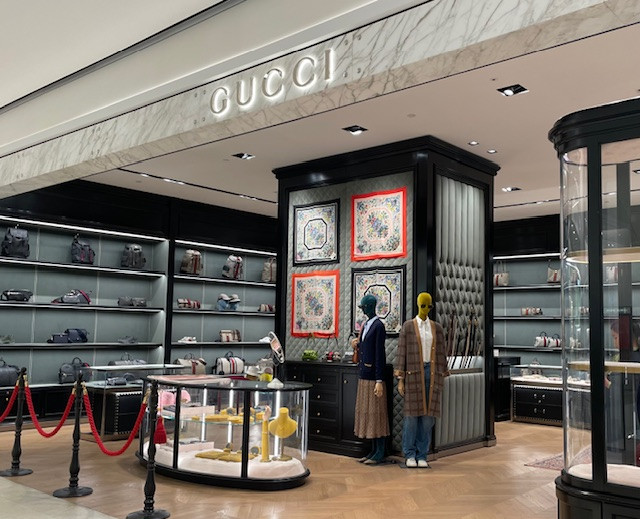
Toronto Holt Renfrew Gucci storefront on March 19, 2024 (Charlene Hatcher)
Lipkus Law confirmed that although most brands offer authentication services in their head office and usually have a certified counterfeit department, it would be impossible for store employees to identify counterfeit goods due to the high numbers of seasonal styles over the years, resulting in thousands of products having been designed.
So, is there a way to balance upholding the law with a person’s constitutional right against search and seizure if they’re suspected of carrying a fake, but are not otherwise committing a crime? It’s a trickier balance than expected. Whalen puts forth the example of an undercover operation he embarked on with ties to organized crime.
After communicating online with a person selling a “luxury handbag” for $350, Whalen pulled up to an agreed upon location in an unmarked car, wad of cash in hand. The exchange was simple: the seller counted each crisp paper bill, neatly folded them into his pocket then handed the bag over to Whalen, no questions asked. What the seller didn’t know was that he had just participated in an undercover sting.
Valued at $30, the bag’s manufacturer was traced back to a Chinese factory, much like the EU has also observed. There, hundreds of overworked slave labourers produce goods to be shipped overseas and, in the most severe cases, the goods end up in the hands of gangs like the “Big Circle Boys” (BCB), notorious for human trafficking and money laundering. In fact, the Hong Kong-based gang has been selling counterfeits in Toronto for several years, making them a closely watched group on the Toronto Police radar while Canadians continue to unknowingly fund the group. The waters become muddied if the purchaser knew the origins of the bag and where their money was going, TPS said in a statement, but
most of the time the investigation looks to the importer as the root of the problem.

Can you spot the fake? These handbags were both found in Toronto, with one costing 10x more than the seized counterfeit version. (Answer: left, Gucci. Right, counterfeit)
Without naming any specific investigations, Detective David Coffey says, “It is believed that organized crime groups are responsible for a vast majority of the counterfeit goods entering the country. The TPS is always willing to cooperate with any federal agency, the CBSA, the RCMP, etc., in the furtherance of any counterfeit goods investigation,” but refused to comment on local operations regarding the BCB.
Selling fakes isn’t something the BCB makes attempts to hide, Whalen says, and there’s no shortage of ads from the gang, even if TPS is less willing to give up information on the group. So, I put this to the test, opening a conversation with a GTA-based member of the Chinese gang.
After finding a “replica” Louis Vuitton handbag on Facebook Marketplace, I reached out to the seller to ask a few questions, making it clear they were for an online news page investigation I was working on. However, before I could even type the questions out, he immediately boasted about being part of the BCB and hiding behind “hundreds of profiles,” saying he’d tell me “everything you need to know” for my research in exchange for one “public service”: $4,000, in cash, up front. The seller became hostile and aggressive when I explained that it is unethical to provide payment as a journalist, and he quickly jumped the price up to $10,000, the message accompanied by sending me additional photos of his counterfeit collection. A few days after ceasing communication, the seller sent more messages, accompanied by his phone number and copies of legal documents he’d been served by a law firm representing Gucci and Louis Vuitton, now ready to talk without any form of payment. However, when I said I couldn’t speak at the time he arranged that evening, he blocked my profile online and refused to answer the calls.
With no sign of the Canadian government looking to crack down further on the issue, Whalen says his network and the work they do as a team is what counts, even if the number of counterfeits hitting the market far outnumbers the amount confiscated. Since locating and keeping track of who’s who is becoming increasingly difficult, with the rise of social media resulting in thousands of seemingly different profiles tracing back to one device without any credible information to solve the case, selling fakes has never been so easy to do and so hard to stop. It’s these instances when law enforcement relies on previous cases to predict how the operation will play out, with law enforcement serving legal documents only when they can say “beyond a reasonable doubt” the person is aware of the widespread consequences of their business, both in Canada and abroad.
However, for people like Lee that have always had an interest in the industry, counterfeits are just one more hurdle they must cross, rather than a deterrent.
“I’ve always had a fascination with fakes,” she said. “Of course, I wouldn’t buy one and I didn’t wear the Prada bag when I found out it wasn't real. I didn’t care enough to return it, so I just gave it to a friend, but I still collect bags and I probably will keep doing it. You just have to be careful nowadays.”


Comments